Capturing the cosmos requires more than just pointing your camera skyward. The secret to breathtaking astroimages lies in mastering sub-exposure timing and technique. 🌌

Understanding Sub-Exposures in Astrophotography
Sub-exposures represent individual frames captured during an astroimaging session. Rather than taking one long exposure, astrophotographers capture multiple shorter exposures that are later stacked together. This technique revolutionizes night sky photography by reducing noise, minimizing the impact of tracking errors, and allowing greater control over the final image processing.
The fundamental principle behind sub-exposures is simple yet powerful: combining multiple frames averages out random noise while preserving genuine signal from celestial objects. Think of it as building a puzzle where each piece contributes to the final masterpiece, but imperfections in individual pieces become invisible when assembled correctly.
When light from distant galaxies, nebulae, or star clusters reaches your camera sensor, it arrives alongside various forms of noise—thermal noise from the sensor itself, light pollution from surrounding areas, and atmospheric interference. Single long exposures amplify these unwanted elements, but multiple shorter exposures give you the mathematical advantage of signal-to-noise ratio improvement through stacking.
The Science Behind Optimal Exposure Length ⏱️
Determining the perfect sub-exposure length involves balancing multiple technical factors. Your camera’s sensor characteristics, the brightness of your target, sky conditions, and mount accuracy all influence this critical decision.
The exposure time must be long enough to capture meaningful signal from your deep-sky target while remaining short enough to prevent star trailing from mount imperfections, minimize the impact of satellite or airplane passages, and avoid saturating bright stars in your field of view.
Sensor Characteristics and Read Noise
Modern CMOS sensors and older CCD sensors behave differently when it comes to sub-exposure optimization. Read noise—the electronic noise introduced each time the sensor is read—plays a crucial role in this equation.
For cameras with high read noise, longer sub-exposures are generally preferable because the signal accumulation outweighs the noise penalty from each readout. Conversely, modern low-read-noise CMOS sensors perform exceptionally well with shorter exposures, as the read noise becomes negligible compared to other noise sources.
Understanding your camera’s read noise profile helps you make informed decisions. Many CMOS cameras achieve optimal performance with sub-exposures between 60 and 180 seconds, while some sensors excel with exposures as short as 30 seconds when combined with sufficient frame counts.
Calculating Your Ideal Exposure Time
Several practical methods help determine optimal sub-exposure duration for your specific equipment and targets. The most reliable approach involves test shots and histogram analysis.
Start by capturing test exposures at different durations—30 seconds, 60 seconds, 120 seconds, and 180 seconds. Examine the histogram of each frame, looking for the background sky level. Ideally, your histogram peak should fall between 20-30% of the maximum value for the selected bit depth.
The Sky Background Method
This technique focuses on achieving proper sky background exposure without overexposing stars or losing faint signal in underexposed shadows. When your background sky sits comfortably in the histogram’s lower third, you’ve captured sufficient photons while maintaining headroom for bright objects.
Light pollution influences this calculation significantly. Under Bortle 7-9 skies (heavily light-polluted areas), sub-exposures often need to be shorter—typically 60-120 seconds—to prevent the background glow from dominating your data. Dark sky sites with Bortle 2-3 conditions allow longer exposures of 180-300 seconds or more.
The Star Trailing Limitation
Even with precise autoguiding, no mount tracks perfectly. Atmospheric refraction, mechanical flexure, and periodic error introduce small tracking irregularities. Your sub-exposure length must accommodate these imperfections without producing elongated stars.
A practical rule suggests keeping sub-exposures short enough that tracking errors remain below one pixel of movement. For a mount with ±5 arc-second tracking accuracy and a camera setup yielding 2 arc-seconds per pixel, exposures up to 150 seconds should produce round stars with proper guiding.
Matching Exposure Strategy to Target Type 🎯
Different celestial objects demand different exposure approaches. Bright planetary nebulae require vastly different treatment compared to faint galaxy regions or expansive emission nebulae.
Emission Nebulae and Deep-Sky Objects
Classic targets like the Orion Nebula, Eagle Nebula, or North America Nebula benefit from moderate sub-exposures of 120-300 seconds. These objects contain both bright core regions and faint outer structures requiring careful exposure balance.
Consider using multiple exposure lengths for high-dynamic-range targets. Capture shorter 60-second exposures to preserve detail in bright cores, then longer 180-300 second exposures to bring out faint surrounding nebulosity. Combining these datasets during processing yields images with exceptional detail across all brightness levels.
Galaxies and Faint Structures
Distant galaxies often require longer individual exposures to penetrate through noise and reveal delicate spiral arms, dust lanes, and outer halos. Sub-exposures of 180-360 seconds work well for galaxy imaging, provided your mount can maintain accurate tracking.
The Andromeda Galaxy presents unique challenges due to its enormous angular size and brightness variation. The core saturates easily while the outer regions remain faint. Multiple exposure lengths become essential—perhaps 30-second exposures for the core and 180-second exposures for the outer spiral structure.
Wide-Field Milky Way Imaging
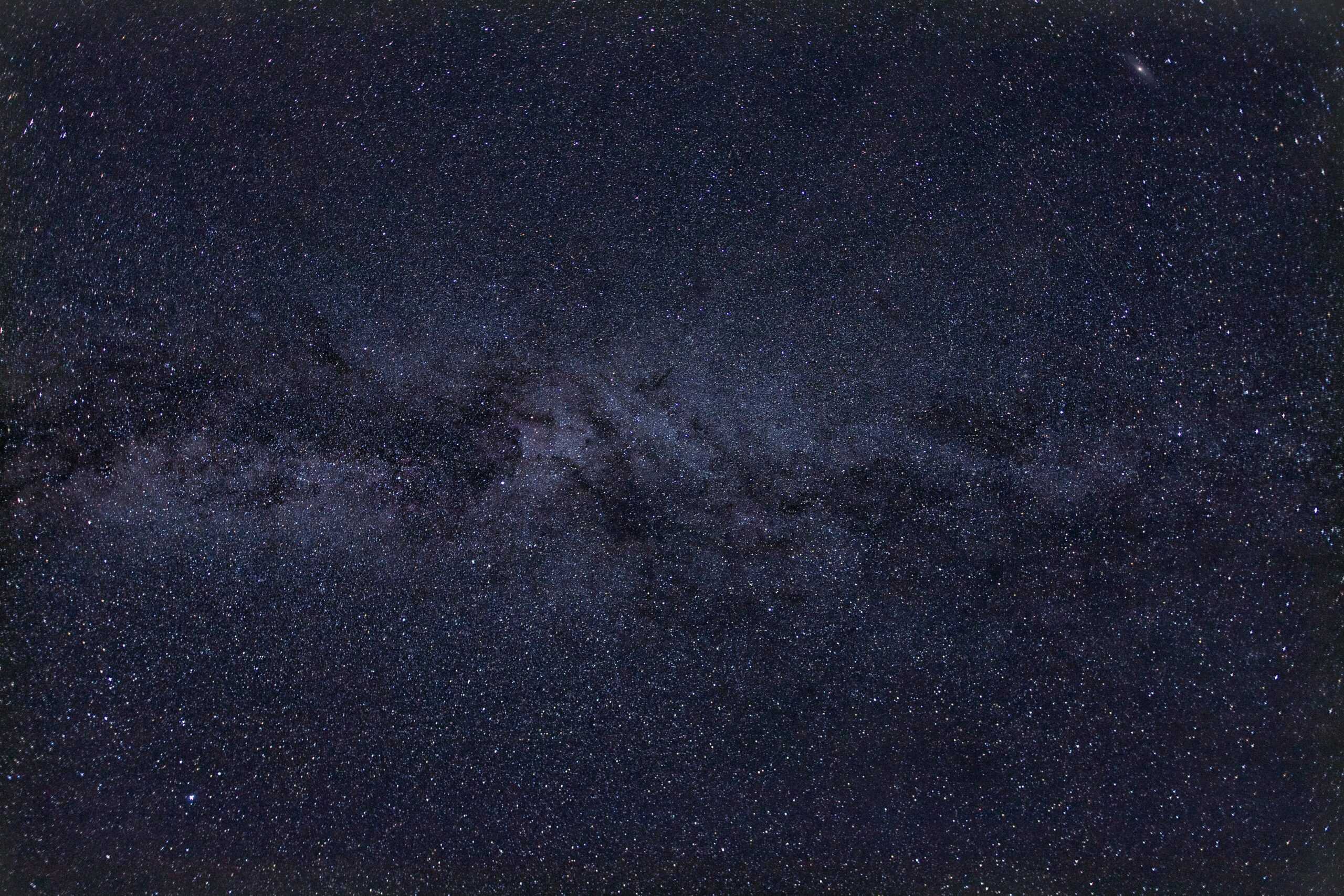
Capturing the galactic core or Milky Way arch requires shorter exposures due to wider fields of view magnifying any tracking imperfections. Sub-exposures of 30-90 seconds typically work best for wide-field astroimaging with camera lenses ranging from 14mm to 85mm focal length.
Tracked wide-field imaging offers tremendous advantages over single untracked shots. Even modest 60-second exposures tracked accurately provide dramatically better signal-to-noise ratios than 15-second untracked shots, revealing countless stars and nebulous regions invisible in single frames.
The Total Integration Time Equation
Individual sub-exposure length represents only half the equation. Total integration time—the sum of all accepted sub-exposures—determines your final image quality and depth.
Signal-to-noise ratio improves proportionally to the square root of total exposure time. Doubling your integration time from two hours to four hours doesn’t double image quality but improves it by approximately 41%. This mathematical reality explains why serious astrophotographers invest entire nights capturing hundreds of sub-exposures.
Practical Integration Time Goals
For typical deep-sky objects under moderately light-polluted skies, minimum integration times worth pursuing include:
- Bright nebulae and galaxies: 2-4 hours total integration
- Moderate targets: 4-8 hours total integration
- Faint targets and dark nebulae: 8-20+ hours total integration
- Competition-level imaging: 20-100+ hours total integration
These numbers might seem daunting, but remember they accumulate across multiple nights. Capturing 120 frames at 180 seconds each yields six hours of integration—a solid foundation for impressive results.
Dithering Strategy and Frame Management 📊
Dithering—slightly shifting your telescope pointing between sub-exposures—provides enormous benefits during stacking. This technique helps eliminate hot pixels, reduces walking noise patterns, and mitigates vignetting effects.
Implement dithering every 3-5 frames, moving the field by 5-15 pixels in random directions. Your stacking software then aligns frames using star patterns, causing fixed-pattern noise to average out while authentic celestial signals reinforce each other.
Frame Rejection and Quality Control
Not all sub-exposures deserve inclusion in your final stack. Airplane trails, satellite passages, tracking glitches, sudden seeing deterioration, or clouds passing through warrant frame rejection.
Modern stacking software includes sophisticated algorithms for automatic frame evaluation based on parameters like star roundness (eccentricity), full-width half-maximum measurements, and background variation. Setting appropriate rejection thresholds ensures only quality data contributes to your master image.
Practical Workflow for Exposure Planning
Successful astroimaging sessions require careful planning before heading outside. Your exposure strategy should account for target altitude changes, moon phase and position, expected sky transparency, and realistic time availability.
Begin by calculating your target’s transit time—when it reaches maximum altitude and optimal viewing conditions. Plan your imaging session around this peak period, allocating your longest continuous imaging time during these premium hours.
Creating an Exposure Timeline
Structure your night strategically. If your target transits at midnight and you have six hours available from 9 PM to 3 AM, concentrate your efforts during the 10 PM to 2 AM window when the target exceeds 45 degrees altitude.
For a galaxy requiring 180-second sub-exposures with 30 seconds overhead between frames (download time, dithering, guiding stabilization), you’ll capture approximately 17 frames per hour. A four-hour prime window yields roughly 68 frames totaling 3.4 hours of integration time—excellent progress toward your imaging goals.
Environmental Factors Affecting Exposure Decisions 🌡️
Sky conditions dramatically influence optimal exposure strategy. Atmospheric seeing, transparency, humidity, and temperature all impact your sub-exposure effectiveness.
Poor seeing conditions (atmospheric turbulence causing star scintillation) argue for shorter sub-exposures. When stars dance wildly, shorter frames increase the likelihood of capturing moments of better stability. Longer exposures in poor seeing simply blur all the atmospheric disturbances together.
Temperature Considerations
Sensor cooling proves critical for noise management during long exposures. Thermal noise doubles approximately every 5-6 degrees Celsius of sensor temperature increase. Cooling your camera to -10°C or -20°C dramatically reduces dark current noise, enabling cleaner longer exposures.
Uncooled cameras perform better with shorter sub-exposures and aggressive dark frame calibration. During summer months when ambient temperatures exceed 25°C, consider limiting uncooled camera exposures to 60-90 seconds maximum to control thermal noise.
Advanced Techniques: Drizzle Integration and Subsampling
Sophisticated processing techniques can extract additional resolution from your sub-exposure data. Drizzle integration, originally developed for Hubble Space Telescope image processing, reconstructs higher-resolution images from undersampled data.
This technique works best when you’ve implemented proper dithering and captured sufficient frames. By combining positional information from dithered exposures, drizzle algorithms can recover detail smaller than your native pixel scale, effectively improving image resolution by 50-100%.
Balancing Narrowband and Broadband Exposures
Narrowband imaging through specialized filters like H-alpha, OIII, and SII requires significantly longer sub-exposures than broadband RGB imaging. The extreme selectivity of narrowband filters—passing only 3-7 nanometers of spectrum—means far fewer photons reach your sensor.
Typical narrowband sub-exposures range from 300-900 seconds (5-15 minutes), with total integration times often exceeding 3-5 hours per filter. The reward for this patience is spectacular images revealing ionized gas structures invisible to standard broadband filters, even under light-polluted skies.
Building Complete Datasets
A complete astroimaging dataset typically includes multiple exposure types:
- Light frames: Your actual target exposures
- Dark frames: Matching exposures with the lens cap on for thermal noise calibration
- Flat frames: Exposures of uniform illumination for vignetting correction
- Bias frames: Zero-duration exposures capturing read noise patterns
Proper calibration frames improve final image quality as much as additional integration time. Capture 20-30 darks matching your light frame exposure duration and temperature, 20-30 flat frames at the same camera settings, and 50-100 bias frames.
Real-World Examples and Timing Recommendations
Translating theory into practice requires examining specific scenarios. Consider these example exposure strategies for popular targets:
Orion Nebula (M42): Use 30-60 second exposures for the bright core region with 50-100 frames minimum, plus 180-300 second exposures for outer nebulosity with 40-60 frames. This dual-exposure approach captures both the intensely bright Trapezium region and faint surrounding clouds.
Andromeda Galaxy (M31): Employ 120-180 second exposures targeting 80-120 frames for total integration of 3-5 hours. The galaxy’s large apparent size and moderate surface brightness make it ideal for intermediate exposure lengths.
Whirlpool Galaxy (M51): Utilize 180-300 second exposures with 60-100 frames targeting 4-6 hours total integration. This face-on spiral galaxy rewards long integration times with exquisite spiral arm detail and companion galaxy structure.
Troubleshooting Common Exposure Problems 🔧
When sub-exposures don’t yield expected results, systematic troubleshooting identifies the culprit. Star trailing indicates tracking problems—either inadequate polar alignment, insufficient guiding, or mechanical issues like loose connections or excessive backlash.
Excessive noise suggests inadequate exposure length, insufficient sensor cooling, or light pollution overwhelming your signal. Addressing these issues might require longer sub-exposures, better dark frame calibration, or narrowband filters to combat light pollution.
Clipped highlights in bright stars or nebula cores mean sub-exposures are too long for the dynamic range present. Reduce exposure time or implement multiple exposure lengths to preserve detail across brightness ranges.
Embracing the Journey to Astroimaging Excellence
Mastering sub-exposure strategy transforms astrophotography from frustrating guesswork into predictable results. The perfect balance emerges from understanding your equipment capabilities, recognizing target characteristics, adapting to environmental conditions, and maintaining patience throughout the process.
Every imaging session provides learning opportunities. Analyze your results critically—examine star shapes across the frame, evaluate noise characteristics in smooth regions, assess whether faint details emerged as expected, and determine if bright areas retained detail or clipped.
Your exposure strategy will evolve as you upgrade equipment, encounter different targets, and develop processing skills. The fundamentals remain constant: capture sufficient signal while managing noise sources, maintain tracking accuracy throughout exposures, collect adequate calibration data, and accumulate meaningful total integration time.
Building Your Personal Exposure Strategy Framework
Develop a systematic approach tailored to your equipment and imaging conditions. Document your sessions meticulously—record exposure lengths, frame counts, sky conditions, seeing estimates, and mount behavior. This data becomes invaluable for planning future sessions and understanding what works best for your specific setup.
Create exposure templates for different scenarios: bright targets under light pollution, faint galaxies from dark sites, wide-field Milky Way panoramas, or narrowband nebula imaging. Having pre-calculated strategies saves valuable dark-sky time and increases your confidence during imaging sessions.
Remember that no single exposure length suits all situations. Flexibility and adaptability separate competent astrophotographers from true masters. When conditions change mid-session—clouds roll in, seeing deteriorates, or wind increases—adjust your strategy rather than stubbornly continuing an ineffective approach.
Reaching for the Stars with Confidence 🌟
The path to stunning night sky images requires dedication, but understanding sub-exposure optimization accelerates your progress dramatically. Armed with knowledge about sensor characteristics, exposure calculations, target-specific strategies, and environmental adaptations, you’re equipped to capture breathtaking cosmic vistas.
Start tonight by evaluating your current exposure approach. Test different durations systematically, analyze results objectively, and refine your technique based on evidence rather than assumptions. The universe rewards patience and precision with imagery that inspires wonder and showcases the magnificent beauty dwelling in our night sky.
Your journey into astroimaging mastery continues with every frame captured, every technique tested, and every lesson learned under the stars. The perfect balance in sub-exposures awaits discovery—uniquely optimized for your equipment, your skies, and your artistic vision of the cosmos.